Never Done: I uploaded most of my Fall JCC performing arts program online
Some days you set world records, and some days you do data entry. And strangely, some days you feel as good about one accomplishment as the other. The last thing hanging over my head that I've been struggling to learn at work has been a website management program called Program Manager. (Version 3! Woohoo!) Someone tried to teach it to me on my second day, and my brain froze up. Then someone tried to teach it to me during my second week, and my brain froze up. Then I didn't do anything with it until the woman who does the marketing for my department gently reminded me that I need to get my programs up online. So backed up against an actual deadline, I opened the program and tried to figure it out. I'm not going to do a blow-by-blow on this one, except that it required enormous humility. I probably got up and asked D for help 25 times today -- sometimes I knew I was asking questions she had just answered. But she answered me again -- with patience, and clarity, and equanimity when I put in the wrong program code and we had to delete the entire whatzit before re-entering it into another wherezit, and the line break was after this word when it was really supposed to be after that word. You get what I'm saying -- boring shit. But boring shit that makes my programming go up online -- here.
What's that you say? Why is it a confusing mess? Because I haven't learned how to do it all correctly yet, and also because we haven't separated out what is actually in my season vs what is a theater rental. But all this media management in good time my friends, all this in good time. (And by the way, I recommend that if you are in NYC, you click on Monajat -- and buy some tickets to come see Galeet Dardashti, because she's fantastic -- and how often do you get a chance to hear incredible Persian Jewish music?) (Ooh, another Never Done -- a plug for my program in my blog.)
So I guess this is a post about balance. In order to program a good season, I need to have a fully developed right brain, but in order for anyone to know about it, I need to have a fully exercised left brain. And I really can't fall into the trap of valuing one over the other.
Showing posts with label Equanimity. Show all posts
Showing posts with label Equanimity. Show all posts
Friday, August 5, 2011

Sunday, May 29, 2011
I swam in the Hudson River
Never Done: I swam in the Hudson River
I wanted to get in the Hudson River well before the triathlon so I could get a feel for what it is like to swim in the river before I do the triathlon in August. I knew of course that it would be a lot colder now than then, but I wanted to feel the chop, and the pull of the tide, and most of all -- what it is like to swim in a wetsuit -- so I signed up for three open water swims this summer -- the Great Hudson River Swim in the Hudson, a The Pancake spring triathlon in Raritan Bay, and the Brooklyn Bridge Swim in the East River.
The Great Hudson River Swim is a "beginner-friendly" (as per the NYC Swim website) 1.6 miles in the Hudson, from Christopher Street Pier 45 to Battery Park City. I was was worried about it being cold, and worried about what it would be like to swim in a wetsuit, and quite nervous about the start, when I'd been told people would jump in and swim on top of me -- but I was pretty confident about the swim itself. I've swim long distances before, I love the open water, I am in great shape right now -- and doing especially well in the pool.
Still, as I approached the sign-in area at 6 AM, I had knots in my stomach. I wasn't sure why I was nervous, because this wasn't a race for me; it was an experiment. My nerves calmed down as I signed in (first person to get my number: 208) penned in Sharpie onto the backs of my hands. They calmed down more as I waited an hour and a half for the swim to start, put on my wetsuit, and joked and talked with other swimmers.
Finally it was time to jump off the Pier, into the Hudson. Everyone says that the hardest part is the beginning, when other people are jumping in on top of you, so I made a deal with the person in front of me and behind me -- told them I wouldn't jump on them, and they shouldn't jump on me. It loosened things up a little bit, and made me feel better to have that level of human connection about the scariest part.
I was in the second wave of swimmers, so I got to see other people jump in and gather together to wait for the start. When my turn came, it felt otherworldly. I was on the edge of the dock, I was told to jump in, I hesitated for maybe 1 second and the man running the show told me to hurry, and so I jumped -- over my own natural tendency to take a little more time -- but I jumped. My goggles stayed on, and the water was chilly but not unbearably cold. (I had a sleeveless wetsuit, and that was just fine.) We waited a good 10 minutes in the water before our heat took off, and during that time I talked with the other swimmers, and waved to Josh who was supporting me from the pier, and thought cockily to myself, Well the hardest part is over. Nobody jumped on top of me, and this water is not too cold.
Finally we heard the countdown and the horn, and we were off -- and it immediately got hard. I set out nice and slow, and within a minute someone was swimming on top of me. I just pulled aside to let them pass, and started again -- and again, someone started to flail on top of me. It felt strange -- there was plenty of room for us to spread out, so I wasn't sure why they were on me, unless they couldn't see or they were panicking or they were assholes. (Probably it was at least one of those reasons.)
Meanwhile, I already hated the wetsuit. It was tight around my neck, and I was having a tough time breathing. Not from exertion -- I had barely exerted yet -- but I think from the compression of the wetsuit combined with my already-compromised lungs combined with the water temperature combined with my reaction to other people swimming on top of me. I couldn't take a significant breath, and I just wanted to rip the wetsuit off from around my neck and chest. I slowed down and let everyone pass, and just tested out what it was like to swim without anyone around. The strokes felt fine, but I could not breathe right. I didn't feel panicked at all -- I just knew that without breath, I wouldn't be able to swim a mile and a half. With a sinking feeling (metaphorically, not literally) I swam over to one of the rescue kayaks and told the guy in it that I shouldn't do this. I felt really disappointed, and also realistic.
He pointed me to the big rescue motor boat, and asked if I needed help getting there. I didn't -- I could swim over there just fine. (I mean, as fine as you are when you can't get a breath and you want to rip off your wetsuit, but really actually fine.) On my way over, it occurred to me that I could take off my wetsuit and get back in the water -- that this didn't actually mean the swim was over for me. So when I got up on the boat, I took off my suit, and asked the rescue captain if that was fine. He wasn't actually a race official, so didn't really care one way or the other. So I did it -- I jumped back into the Hudson without a wetsuit, and set back out on the course. Again, the water temp was fine on my limbs, and it felt great to be in my element without the wetsuit on, but I still couldn't get a breath. (In the end, all day and night passed without my being able to take a significant breath, so the fact that I couldn't get it in 62 degree water isn't a surprise.)
I went through the same process of disappointment and reality all over again, swam back to the rescue boat, and climbed back up. My Great Hudson River Swim was over. Lung fail.
But it turned out it wasn't over. Because I stayed on that boat -- with the two captains and the three other swimmers who got picked up -- for another 45 minutes. I tried to talk with the other swimmers, but they were pretty sulky. One of them had a cut hand, one of them was "off his game" and the other one wouldn't even talk. A sorry bunch, feeling sorry for themselves, while meanwhile, I felt surprisingly emotionally OK. I watched the swimmers in the water, and the rescue kayak culture -- trying to learn as much as I could from my unexpected vantage point. I felt a lot of appreciation for the boating support team. I watched the slow swimmers and noticed how good they were at taking their time, and also that they actually had support kayaks boating next to them. Had I understood that I would have had that level of close support, I would have stayed in the water, and while that increased my disappointment that I had gotten out, it also felt like it was still the point of doing the swim in the first place -- to experiment and to to learn.
In other words, I decided to practice Humility: Seek wisdom from others, and not to sink into humiliation.
Until later, once I was on land again, and I started to feel my confidence tank. If you've been around me over the past months, you've heard me sound pretty cocky about the swim -- saying again and again that the swimming part of the triathlon is no problem. I'm a great swimmer. My weak sports will be biking and running. Well damn, if I can't breathe in a wetsuit, it doesn't matter how good a swimmer I am.
I told Josh about all of this on the way home, and we discussed the etymological roots of the words humility and humiliation because I wanted to know how closely related the two things are. We weren't actually sure about the derivation, but Josh gave me a wonderful definition of what he felt I'd been through: Humiliation is being dragged kicking and screaming into a state of humility.
Later in day, he went out while I was napping, and came home with a beautiful spray freesias, and a redefinition of my entire race day. He said there were 6 waves of races: 5 waves of swimmers, and one boating wave. And then he said that I placed first in the boating wave, because I practiced so much equanimity and patience and humility.
Now I just have to keep practicing all three, as I strategize my way forward. Can I swim without a wetsuit? If I do that, do I just swim in my tri shorts and top? What about wearing a neoprine vest? Or maybe a one-piece trisuit? And maybe more importantly than all that, what is really going on with my lungs? Why does it feel like the rest of my body is getting stronger and stronger, while I can't get a full breath? I think it's time to practice diligence, and take my compromised lungs to the doctor. Onward.
Thursday, April 7, 2011
I (reluctantly) upgraded to Snow Leopard
Never Done: I upgraded to Snow Leopard (Mac operating system) after spending 6.5 hours at the Mac genius bar and still not entirely resolving my calendar syncing issues
Do I sound bitter? I think I have every right to be, but the truth is, the guys I spent the afternoon - and evening - with were fantastic. They made the practices of Humility: seek wisdom from others and and Equanimity: Rise above events that are inconsequential much easier than they could have been. I had to miss my Mussar group. I had to miss my workout. I had to buy dinner out (but I turned it into a Never Done opportunity by going to the Chelsea Market, which is amazing, vast, and as Mickey put it, like Wonkaland, with all the delicious things to offer.)
Briefly, the deal is that ever since I bought my computer and iPhone, the syncing has given me trouble. Randomly, contacts and calendars will duplicate. I've spent hundreds (not an exaggeration) of hours troubleshooting, cleaning up, and fixing the problem, only to have it happen again. Apple has told me that "some people have this problem" and hasn't been able to solve it. Recently something worse happened -- my entire calendar disappeared. I've been trying to work that out on my own for about a month, and then today I finally went in for help. It turns out that the problem started when Apple created a new iCal, which is not compatible with my operating system -- which is not very old; my computer is a mere toddler, at three. It turns out, the day they launched iCal, it wiped my calendar. And then when I started to re-build it (from memory and old backups) it would not sync with my iPhone. This problem was so deeply hidden that it took four hours and two Mac Genius guys and three MobileMe online chat specialists (the Geniuses were on the chat line with the MobileMe specialists) to conclude that my "old" operating system was just not going to support this new calendar. But damn, were they persistent! And diligent. And good-natured. And communicative.
So if they weren't the problem, what was? I think it's the Apple corporation, who upgraded their calendar to something that is incompatible with the machines of millions of users, and so are forcing millions of people to upgrade their Operating System (as of May 5.) And this doesn't come free. Snow Leopard costs $39 (although my Geniuses gave it to me for "free.") (The quotation marks, in case you missed it, are supposed to indicate that spending 6.5 hours of my time isn't exactly free.)
And yet, somehow, I have brand loyalty to Apple. Maybe it's because their machines are so pretty, and maybe it's because they're so user-friendly to intuitive types like me, but maybe it's because of guys like Chazz, who stayed well past the time the Genius bar was closed, to see me through to resolution (for now.)

(Update: new problem, discovered the following morning: now that I upgraded to Snow Leopard, iTunes doesn't recognize my iPhone. iThink that sucks.)
Wednesday, February 23, 2011
I put up art in public places
Never Done: Made art and hung it up for people to see or take
Such a simple thing -- make some art, and put it out in public for everyone to see. It's hard to believe I have never done this, but I can't actually think of a time that I did. Avia and Christian came over for dinner, and my original idea was to do go yarn bombing with Avia, but we were getting together on the late side, so that idea will have to wait to share with a local knitty friend.
Instead, we took out paper, Sharpies, scissors, and whatever magazines I had around (dozens of New Yorkers, New York, and New York Times Magazines, and one Vanity Fair) and we started cutting up images and making simple little collages. Actually, I think the art concept started with my telling the others that Rufus Wainwright and his husband just had a baby, and the mother is Lorca Cohen -- the daughter of Leonard Cohen. (She really is the mother, not just the surrogate or the birth mother; the three of them are all parents, and intend to raise their daughter, Viva Katherine, together.)
Anyhow, I told this news to Avia, who loves Leonard Cohen, and on cue, she swooned. I told her about the deal my friends Karen and Andy have -- a celebrity exclusion, let's call it -- whereby each of them can pre-name one famous person to whom, if they happened to knock on the door and make a carnal offer, it would be OK to say yes. (I believe that you can change celebrities as often as you like, but you can only take the offer of the currently-named celebrity. I also believe that Scarlett Johansson and Johnny Depp have had no recent challengers.)
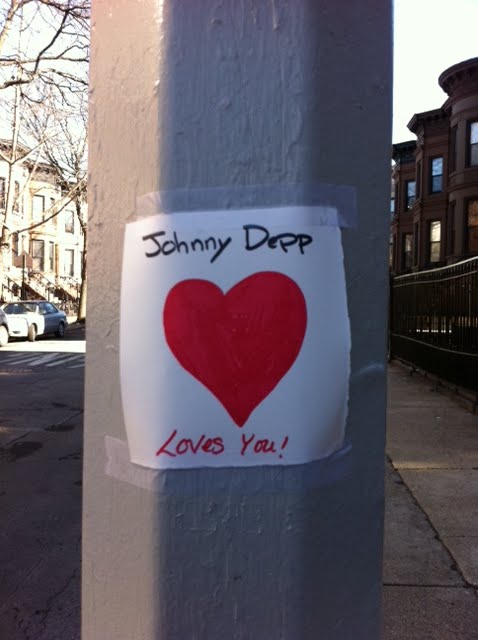
On the mention of Johnny Depp, our art project was born. Avia took a card, and wrote Johnny Depp Loves You on it, with a big red heart. We each then started making cards with similar messages. Prince Loves You. Lady Gaga is Gaga Over You.
Then I made one that says Alice Walker wrote a book about you, and I decorated it with a little collage made of the color purple. And then I made one that says Oprah thinks you're smart. And Christian dazzled the table with Cezanne Painted Me, Europe Loves You, and the one that melted my heart the most: simply, I Love You.
I had hoped we would all go out together and hang them and photograph them, but it was both late and dark, so we split them up (without looking, so we could neither intentionally choose our own or our favorites) and decided to hang them and photograph them in the morning. To be honest, it was hard to let the art pieces go -- I wanted to chaperone them all into the world. I wasn't very gracious about this either, when I woke up and found that Josh had taken some to put up. I completely understood why he had -- because I hadn't had the time to tell him I hoped we could do it together. It was an opportunity to practice many of the mides (middot) -- patience, order, and equanimity come to mind -- but I don't think I did a good job with any of them. Instead, I can reflect on what was so hard for me, and hopefully be more relaxed the next time.
I feel like the blog has gotten away from a Mussar perspective lately -- and this Never Done activity has brought me back, because it was such a wonderful combination of self and other. I thoroughly enjoyed making the art, and sharing the art making process with others, and being influenced by their ideas (humility.) And when I did go out and chaperone some pieces into the world, putting them up allowed me to think about how others might encounter them and be moved by them. It was both a public gift and also a private gift -- public art speaks to individual people, and so I tried to place them where everyone could see them, but knowing that certain people would relate to them in a special way. The most successful of these was when I hung I Love You on the fire station door frame. I also liked thinking about how they might be left or taken -- that I was giving individuals the opportunity to leave the art there for others, or to take it for themselves. And that it really wasn't up to me to know what was the right thing for any individual to decide to do.




Saturday, February 19, 2011
I can see nearly now
Never Done: Got rad new wear-all-the-time glasses
They look great from the outside looking in, but so far they are terribly confusing from the inside looking out. I can sort of read with them. I can sort of see far with them. I can barely use the computer with them. The point, of course, is for me to seamlessly do all three. I was ready for how there would be little strata of vision, like sedimentary rock, and how I'd have to gently move my head up and down to find the right spot for the job. What I wasn't prepared for is how there would ALSO be a big bite out of each side, like two big bites, and how I can't ever move my head or eyes from side to side, and how even if I find the one teeny tiny place where I can see a three inch square of the screen, I still can't actually see it clearly.
Sometimes getting older sucks.
And it's hard to relate to the younger me who, when I had 20-20 vision, wanted glasses because I felt like I was missing out on a fashion opportunity. Which, let's face it, I was. But you know what else I was missing out on? Not being able to see. Pushing my glasses up off my nose. (I know, I have to go back to the store to get them adjusted.) Young men who don't yet need progressive lenses telling me how easy it is to adjust to them. Typos. Lots of typos. Not visual typos, because I don't look at the keyboard when I type, but something cognitive that comes from having a confused and wiggly visual experience. I keep inverting letters, and typing entirely wrong words. Like when I just went back to re-read this paragraph, I found I had written "mission out on" instead of "missing out on."
Supposedly my eyes will adjust to this. Supposedly, I should be able to sit in a meeting and read something, and then look up and see who I am talking to, without taking glasses my glasses off. Supposedly, I should also be able to work at the computer, and then check a hand-written note, and then look across the room at, I don't know, the Old Spice man riding a horse, and all of it will be clear. And supposedly, if I practice every day, starting first thing in the morning when my eyes are supposedly fresh, my eyes will supposedly get used to being trapped in a fun house mirror.
I think this one's gonna take the mides (middot) of patience and equanimity. Also maybe it would be good if we could place an ethical value on vanity, because I'm sure to be more motivated to stumble through my day in a confused blur if enough people tell me how great I look.

Saturday, January 22, 2011
I saw past the blemish to the beauty
Never Done: Saw a staged reading of a new opera of Enemies, A Love Story, by Isaac Bashevis Singer, with a new libretto by Nahma Sandrow
This is the second time in as many months that I have written that the thing I had never done before was to see a world premiere of a work that Nahma either translated or wrote, which has a lot more to say about what Nahma is out there accomplishing than what I am, except that I think that supporting and learning from our colleagues (Humility: Seek wisdom from everyone) is a vital part of the creative process. Really. I once took a master class in acting from Marian Seldes in which she spent as much time (literally) teaching about how to be a good audience member as she taught how to be a good actor. I will probably never forget her modeling how to sit in the audience, leaning slightly forward, in rapt attention -- her point being that the job of the audience member is to give as much attention and energy to the actor as the actor is giving to the audience. Her class reminded me that my friend Barbara teaches first graders how to listen, and they practice sitting across from each other making encouraging sounds like, "mhmm" and "oh." (I found this out because when I still lived in Portland I used to go help her take her class apart at the end of the year, and I found a piece of butcher paper with an illustrated three-step tutorial on how to be a good listener.)
This being New York, and the theater community being small, I later found myself in audiences with Marian, where I saw that she does, in fact, sit perfectly still -- fidgetless -- and completely attentive, with an interested look on her face. Unlike Edward Albee, who sat behind me recently during a Public Theater production that I thought was well above average, and also both politically and emotionally ambitious, and also had one of the best raised poor characters I've ever seen on stage, and he alternately slept and complained through the first act, and then didn't come back for the second. I myself usually fall somewhat in between. I aspire to be like Seldes, but I sometimes fight back the sleep, and sometimes I succumb.
I think I was a good (which as I think about it, means that I was an ethical) audience member at Enemies. I wasn't as still as Marian suggests, because I was still fighting off a sore throat, and needed to sip tea, and once to unwrap a vitamin C throat lozenge. But I paid close attention, and I gave the actors my energy and attention. And here's the thing: it wasn't necessarily so easy to do, because even though I was super interested in the libretto and the plotting, and even though a couple of the singers were wonderful, the guy who played the main character swallowed his words, making it really difficult to understand, and the music was ... well the music was ... well the music was ... I hated the music. There, I said it. I hated the music. It made me want to act out. It made me want to whisper judgmental things to the people I was with. But I didn't. (Unless I am right now. Which I am a little worried that I might be.) Instead, I sat and paid attention to the parts I was far more interested in, which took at least five mides (middot) to accomplish: patience, equanimity, humility, decisiveness, silence, and calmness. And diligence too. In the end, I think everyone was the better for it, but I know I was.
I live with someone who does this extremely well -- he sees right past the blemish to the beauty, whereas my mind tends to get stuck at the blemish. (There are some downsides to this -- cleanliness and order are not his strong suits, but they are mine.) I've been trying to get better at seeing the past the blemish to the beauty for years, and have started to see some real progress recently. I'll take my experience at Enemies as a success, and will keep building from there.
Sunday, November 21, 2010
Bells are Ringing. Bags are crinkling.
Never Done: Bells Are Ringing
I feel a little sheepish that I'm writing so many posts about seeing theater -- like I should be engaging in a greater variety of activities I've never done -- and also I feel like I should warn you that the marathon is not quite over. (In other words, expect yet another theater post tomorrow.) But one of the reasons I live in New York is to see theater and film that I can't see anywhere else, and this has been a tremendous week. My friend Jesse took me to see the Encores production of Bells Are Ringing, a 1956 Broadway musical about a boundary-loose woman who works for an answering service, and who can't help but get involved in her client's lives. Romance ensues.
I love the spirit of Encores. They do concert readings of musicals that have been rarely heard by today's audiences. Every now and then, an Encores production becomes a Broadway revival (I think this is how the most recent Gypsy made it to Broadway) but often they just live for a long weekend on the City Center stage. We sat in phenomenal seats -- front row mezzanine -- which afforded us a clear view of every orchestra instrument. And since Encores features the orchestra prominently on stage, instead of in a pit, I got to pay more attention to the instruments than I usually do. And I noticed some things for the first time. (Shehekhianu.) I noticed that I could hear every instrument in the orchestra -- literally every instrument -- except the piano. I could hear the harp, the violins, the violas, the guitar, the reeds, the flutes, the horns, the drums ... (I hope I am not leaving anything out) but I couldn't hear the piano. I asked Jesse about it at intermission, and he explained to me that the piano doesn't take the melody, and that unless it's got a specific solo, it is there to double the strings and rhythm instruments, to add texture to the sound. For all the orchestral music I have listened to, I had really never noticed this before.
The other sound we noticed, because it was impossible not to, was the elaborate meal the people sitting behind us unwrapped and masticated throughout the entire performance. I literally turned all the way around in my seat at one point to see what could be making such a noise, and saw that it was just an oversized cookie in a little paper bag. (A cookie that I could have extricated soundlessly, and eaten silently.) But this couple didn't seem interested in being soundless or silent. They crunched and crinkled and squeezed and chewed until finally Jesse turned around and spoke to them clearly, firmly, and somehow warmly -- and to my amazement, they put away their metaphorical peanuts and crackerjacks, and we heard to the rest of the show as it was meant to be heard.
I wrote yesterday that this week's mide (character trait that we reflect on in Mussar to help us lead an ethical life) is equanimity: rise above events that are inconsequential. I also wrote that the challenge then is to determine what is of consequence and what is not. There's a reason we're not allowed to bring food into the theater -- it's loud, it's messy, and it smells -- all things that interfere with other people's enjoyment of the production. In other words, it's totally against the rules to bring food into the theater, and even if I'm one to bend bureaucratic rules here and there, these people were also violating all the social rules. So why was it so hard to turn around and ask them to stop when the very rules validate that our concern is legitimate?
In Mussar practice, we are encouraged to ask how difficult situations are for the other, not to focus solely on how they are for ourselves. This is a real sticking point for people who have been socialized to always think about the other and to subsume the self. Luckily, as I've written before, a modern interpretation of Mussar recognizes this dilemma, and asks us to determine what is the legitimate concern of the yetzer hore (the selfish impulse.) It can be a complicated process. I think Jesse and I went through four of the five stages of grief before finding the path to address our legitimate concern.
Denial: That can't be Tupperware. And even if it is, they just need a little snack, and they'll put it away soon.
Anger: Seriously? Cellophane? Seriously? (Turn around and stare at their main course.)
Bargaining: Just let me make it to the intermission.
Depression: What's the point? There's nothing we can do about it.
The fifth stage of grief is acceptance: I can't fight it, I might as well prepare for the worst. But when Jesse decided that we had a legitimate concern, he transcended acceptance and went to a place of powerful engagement. He did it kindly (taking care of the other.) He did it firmly (taking care of the self.) And the end result was that he did it effectively. And I rewarded him with some chocolate I had stashed in my purse.
Saturday, November 20, 2010
I am seaweed
Never Done: Free Man of Color
Never Done: Called Apple to ask them to remove white nationalist iPhone App from iTunes
Tshuve: Time with Tabitha
Tshuve: Brooklyn Soup Swap
I feel like I haven't been writing many tshuve posts, even though I've been enjoying returning to some of the new routines I've recently started. At the end of a very full day, which included reading and marking up the contract for the screenplay option I am still working on (It took five hours to read and mark up this contract. Are any of you reader/friends entertainment lawyers who would like to answer a couple questions for me that my BA in Anthropology/Religion and my MFA in Dramatic Writing didn't prepare me for?); and having a phone meeting about my new international documentary film project, which I am doing with three wonderful people (I will ask them if it's OK to blog about it, and if they say yes, I will give details about it here); and calling Apple customer service to talk with them about why it's a bad idea for them to allow an iPhone/iPad/iPod app for the white nationalist group NumbersUSA .... at the end of that full day, I was hosting Soup Swap at my apartment, and an out-of-town guest for the weekend, and also spending just 20 minutes with Tabitha while her mom went to run an errand -- all while getting ready to go see John Guare's new play A Free Man of Color at Lincoln Center.
Also, it might be helpful for you to know that this week's mide (middah) is Equanimity: Rise above events that are inconsequential.
What I like about this mide is that it implies that there are events that are consequential -- and we just have to be able to figure out which ones they are.
When you are reading a legal contract that is written to represent the rights and responsibilities of two separate parties, the entire actual job is to determine what is, and what is not, consequential. That's why it took me 5 hours to sort through the document -- because it's not always easy to figure that out, even with a law degree. Is it OK if my name is not on the title card following the title card for the director? Maybe yes, maybe no. Is it OK to change the word hereto to herefor? I think it is. Is it OK to sign something that says we would have the first option to write the sequel as a work for hire, with no financial compensation. Um. No. The challenge for me though, is to be able to stay grounded while figuring these things out -- and not let anger, confusion, or frustration cloud my judgment, so I can keep figuring out what is consequential, and what is not. Rabbi Alissa Wise likes to think about a state of equanimity as being like seaweed. You're swept around by tides and currents and waves and storms, but you always stay rooted.
It was easy to stay grounded while talking with Apple Customer Service, because as soon as I explained who NumbersUSA is, and what white nationalism is, she found it to be deeply consequential. Interestingly, she took white nationalism seriously by comparing it to pornography, which is, apparently, the offensive material that most people call in to report.
Later, Tabitha and I were alone together for about 20 minutes, and she cried the entire time we were together. I assumed she was having a hard time understanding that her mom would be back because she hasn't yet developed object permanence, and so I just stayed close to her, and held her, and got down on the floor with her, and talked with her while she cried. I wasn't very thrown by it -- she would check me out every now and then and come crawling on top of me to get a hug, and then recommit herself to crying. So I knew she knew she was OK with me, just really not happy about something. When her mom came back, she told me that this had been going on all day, but Tabitha did get more relaxed when her mom was holding her. Until she suddenly threw up -- a lot -- all over herself, her mom, and a very little bit on the 0% bedbug couch. And just then -- no, really, just then -- our out-of-town guest arrived, with an entire meal she wanted to cook, just then.
So I was getting rags to help clean up the throw-up, and clean clothes for everyone to wear, and plastic bags for the pukey clothes, and accepting a bottle of wine from our guest, and finding a roasting pan so she could make chicken, and answering text messages from Esther who was about an hour late with the 8 quarts of soup she made and was bringing over for people to pick up, and getting dressed to go out to the theater, and finding the tin foil, and answering the door, and ..... I was seaweed. I really was seaweed. I was able to see that there were no crises, and that there were enough adults to do whatever needed to be done, and that Tabitha was feeling better once she got cleaned up, and that it was totally fine that people were going to have a nice dinner in my apartment without me, and that I was going to Lincoln Center to see a play that had gotten horrible reviews.
And you know what? I liked it. First of all, I had insanely good seats. Third row center, to watch Jeffrey Wright and Mos Def. I have definitely never done that before. I would sit in the third row center to watch those two play Monopoly. But also, I liked the play. Mostly. I didn't like Guare's treatment of women in the play, and while that is not inconsequential, I can forgive him for it because he set out to write about the Louisiana Purchase, race and slavery -- and not sexism and the subjugation of women. I admired the ambition of this play -- a play about race in the United States, in New Orleans, in 1801, during a transition from a racially free and mixed society to and racially enslaved one. I thought the story telling was consistent, and I thought the direction was bold, theatrical, imaginative, and also consistent. I was never bored. I was spellbound by Mos's acting. And in an unpredictable reaction, I decided I want to wear bloomers, waistcoats, and high boots this winter, and that I might try to sew myself some. Maybe in a lovely knotted-kelp green with dulse-colored polka dots.
Subscribe to:
Posts (Atom)