Never Done: I met R.L., or how to keep Beginner's Mind even when you're no longer a beginner
I am so new at my job that I could blog about something new I've done every day. For example, yesterday I started filing for a P-3 artist visa to bring someone in for an October performance, but I'm not going to write about it. Instead, I am going to write about the meeting I had with a woman who is the arts and culture consultant to all the JCC's across the country.
The thing I loved most about the meeting is that she made me feel comfortable asking her opinion about things that are intrinsic to my own job -- things that in another context I might not have felt comfortable asking, feeling like I need to prove myself. We had a wonderful conversation about what makes Jewish performance Jewish, and if it's not Jewish, what makes it belong in a Jewish performing arts space. This is a topic I have thought about extensively of course, but now that I actually program a Jewish space, I'm applying my thoughts for the first time, and I'm very interested in what other people have to say about it. So instead of erecting a wall with my own opinions, I asked her what she thinks, and this opened the door to one of the most interesting conversations I've had on the topic to date.
This got me thinking about what can get hard about practicing Humility: Seek wisdom from others; there is so much pressure for us to prove ourselves -- and so much pressure to not show our vulnerabilities. There is so much pressure for us to prove that we are experts, and to pretend that we not actually beginners.
There is a central concept in Zen Buddhism called Shoshin, or Beginner's Mind, that encourages us to approach learning with the open attitude of a beginner -- without preconceptions about our own performance -- even when we are learning at an advanced level. Right now I actually am a beginner at my job, so it's easier than it will become for me to practice Shoshin. But what about in a month, when people get tired of reminding me where certain forms are, or in a year, when I am supposed to be expert? My hope is that I will still be able to meet people and listen openly to their knowledge and experience, while approaching my own areas of expertise with all the openness and lack of self-judgement I would if I were a beginner.
Showing posts with label humility. Show all posts
Showing posts with label humility. Show all posts
Wednesday, August 17, 2011

Friday, August 5, 2011
I uploaded most of my Fall JCC performing arts program online
Never Done: I uploaded most of my Fall JCC performing arts program online
Some days you set world records, and some days you do data entry. And strangely, some days you feel as good about one accomplishment as the other. The last thing hanging over my head that I've been struggling to learn at work has been a website management program called Program Manager. (Version 3! Woohoo!) Someone tried to teach it to me on my second day, and my brain froze up. Then someone tried to teach it to me during my second week, and my brain froze up. Then I didn't do anything with it until the woman who does the marketing for my department gently reminded me that I need to get my programs up online. So backed up against an actual deadline, I opened the program and tried to figure it out. I'm not going to do a blow-by-blow on this one, except that it required enormous humility. I probably got up and asked D for help 25 times today -- sometimes I knew I was asking questions she had just answered. But she answered me again -- with patience, and clarity, and equanimity when I put in the wrong program code and we had to delete the entire whatzit before re-entering it into another wherezit, and the line break was after this word when it was really supposed to be after that word. You get what I'm saying -- boring shit. But boring shit that makes my programming go up online -- here.
What's that you say? Why is it a confusing mess? Because I haven't learned how to do it all correctly yet, and also because we haven't separated out what is actually in my season vs what is a theater rental. But all this media management in good time my friends, all this in good time. (And by the way, I recommend that if you are in NYC, you click on Monajat -- and buy some tickets to come see Galeet Dardashti, because she's fantastic -- and how often do you get a chance to hear incredible Persian Jewish music?) (Ooh, another Never Done -- a plug for my program in my blog.)
So I guess this is a post about balance. In order to program a good season, I need to have a fully developed right brain, but in order for anyone to know about it, I need to have a fully exercised left brain. And I really can't fall into the trap of valuing one over the other.
Sunday, June 12, 2011
I toured the Lesbian Herstory Archives
Never Done: I toured The Lesbian Herstory Archives
One of the highlights of Brooklyn Pride is that The Lesbian Herstory Archives opens up for a book sale. I went for the first time last year -- rummaged around the books for a little bit, and looked at beautiful original photographs of the Michigan Womyn's Music Festival, taken by Angela Jiminez who had recently published a book of documentary photography called Welcome Home.
This year I went again -- with a gaggle of friends -- and lucked into a tour of the upstairs of the archives. Files and boxes and closets and rooms full of papers and other ephemera. Archives and memorabilia of both individuals and organizations. And I had a kind of realization that is not uncommon to me: it took getting in the room and seeing it to understand the meaning and importance of the archive. In fact, it took one specific thing in the room itself: a box labeled Lesbian Avengers.
I was at the first Dyke March in at the LGBT March on Washington in 1993 (created and organized by the Lesbian Avengers) and as I remembered that and dozens more marches and actions and music festivals and my involvement with womyn's land and Ladies Against Women,
suddenly I realized that all the groups and activities I've been involved in over my life add up to archive-worthy history. And that without the archive, our history would be an assortment of individual and collective memories, but not a collection -- not a searchable archive -- not an institutionalized part of history that students and scholars and artists can use to further document, comment upon, and contextualize our lives.
There is so much more to say about this, and yet every time I write a sentence, I erase it because I basically keep writing the same thing over and over again. Our lives are important; our history is important; our lives are important; our history is important. So I think what I want to do here is to thank and appreciate Joan Nestle and Deb Edel and the other founders of the Archive for the vision to create the archive and to them and all the women who built it and maintained it over all these years. Thank you for creating an institution based on the mide (middah) of Humility: Seek wisdom from others.
Sunday, May 29, 2011
I swam in the Hudson River
Never Done: I swam in the Hudson River
I wanted to get in the Hudson River well before the triathlon so I could get a feel for what it is like to swim in the river before I do the triathlon in August. I knew of course that it would be a lot colder now than then, but I wanted to feel the chop, and the pull of the tide, and most of all -- what it is like to swim in a wetsuit -- so I signed up for three open water swims this summer -- the Great Hudson River Swim in the Hudson, a The Pancake spring triathlon in Raritan Bay, and the Brooklyn Bridge Swim in the East River.
The Great Hudson River Swim is a "beginner-friendly" (as per the NYC Swim website) 1.6 miles in the Hudson, from Christopher Street Pier 45 to Battery Park City. I was was worried about it being cold, and worried about what it would be like to swim in a wetsuit, and quite nervous about the start, when I'd been told people would jump in and swim on top of me -- but I was pretty confident about the swim itself. I've swim long distances before, I love the open water, I am in great shape right now -- and doing especially well in the pool.
Still, as I approached the sign-in area at 6 AM, I had knots in my stomach. I wasn't sure why I was nervous, because this wasn't a race for me; it was an experiment. My nerves calmed down as I signed in (first person to get my number: 208) penned in Sharpie onto the backs of my hands. They calmed down more as I waited an hour and a half for the swim to start, put on my wetsuit, and joked and talked with other swimmers.
Finally it was time to jump off the Pier, into the Hudson. Everyone says that the hardest part is the beginning, when other people are jumping in on top of you, so I made a deal with the person in front of me and behind me -- told them I wouldn't jump on them, and they shouldn't jump on me. It loosened things up a little bit, and made me feel better to have that level of human connection about the scariest part.
I was in the second wave of swimmers, so I got to see other people jump in and gather together to wait for the start. When my turn came, it felt otherworldly. I was on the edge of the dock, I was told to jump in, I hesitated for maybe 1 second and the man running the show told me to hurry, and so I jumped -- over my own natural tendency to take a little more time -- but I jumped. My goggles stayed on, and the water was chilly but not unbearably cold. (I had a sleeveless wetsuit, and that was just fine.) We waited a good 10 minutes in the water before our heat took off, and during that time I talked with the other swimmers, and waved to Josh who was supporting me from the pier, and thought cockily to myself, Well the hardest part is over. Nobody jumped on top of me, and this water is not too cold.
Finally we heard the countdown and the horn, and we were off -- and it immediately got hard. I set out nice and slow, and within a minute someone was swimming on top of me. I just pulled aside to let them pass, and started again -- and again, someone started to flail on top of me. It felt strange -- there was plenty of room for us to spread out, so I wasn't sure why they were on me, unless they couldn't see or they were panicking or they were assholes. (Probably it was at least one of those reasons.)
Meanwhile, I already hated the wetsuit. It was tight around my neck, and I was having a tough time breathing. Not from exertion -- I had barely exerted yet -- but I think from the compression of the wetsuit combined with my already-compromised lungs combined with the water temperature combined with my reaction to other people swimming on top of me. I couldn't take a significant breath, and I just wanted to rip the wetsuit off from around my neck and chest. I slowed down and let everyone pass, and just tested out what it was like to swim without anyone around. The strokes felt fine, but I could not breathe right. I didn't feel panicked at all -- I just knew that without breath, I wouldn't be able to swim a mile and a half. With a sinking feeling (metaphorically, not literally) I swam over to one of the rescue kayaks and told the guy in it that I shouldn't do this. I felt really disappointed, and also realistic.
He pointed me to the big rescue motor boat, and asked if I needed help getting there. I didn't -- I could swim over there just fine. (I mean, as fine as you are when you can't get a breath and you want to rip off your wetsuit, but really actually fine.) On my way over, it occurred to me that I could take off my wetsuit and get back in the water -- that this didn't actually mean the swim was over for me. So when I got up on the boat, I took off my suit, and asked the rescue captain if that was fine. He wasn't actually a race official, so didn't really care one way or the other. So I did it -- I jumped back into the Hudson without a wetsuit, and set back out on the course. Again, the water temp was fine on my limbs, and it felt great to be in my element without the wetsuit on, but I still couldn't get a breath. (In the end, all day and night passed without my being able to take a significant breath, so the fact that I couldn't get it in 62 degree water isn't a surprise.)
I went through the same process of disappointment and reality all over again, swam back to the rescue boat, and climbed back up. My Great Hudson River Swim was over. Lung fail.
But it turned out it wasn't over. Because I stayed on that boat -- with the two captains and the three other swimmers who got picked up -- for another 45 minutes. I tried to talk with the other swimmers, but they were pretty sulky. One of them had a cut hand, one of them was "off his game" and the other one wouldn't even talk. A sorry bunch, feeling sorry for themselves, while meanwhile, I felt surprisingly emotionally OK. I watched the swimmers in the water, and the rescue kayak culture -- trying to learn as much as I could from my unexpected vantage point. I felt a lot of appreciation for the boating support team. I watched the slow swimmers and noticed how good they were at taking their time, and also that they actually had support kayaks boating next to them. Had I understood that I would have had that level of close support, I would have stayed in the water, and while that increased my disappointment that I had gotten out, it also felt like it was still the point of doing the swim in the first place -- to experiment and to to learn.
In other words, I decided to practice Humility: Seek wisdom from others, and not to sink into humiliation.
Until later, once I was on land again, and I started to feel my confidence tank. If you've been around me over the past months, you've heard me sound pretty cocky about the swim -- saying again and again that the swimming part of the triathlon is no problem. I'm a great swimmer. My weak sports will be biking and running. Well damn, if I can't breathe in a wetsuit, it doesn't matter how good a swimmer I am.
I told Josh about all of this on the way home, and we discussed the etymological roots of the words humility and humiliation because I wanted to know how closely related the two things are. We weren't actually sure about the derivation, but Josh gave me a wonderful definition of what he felt I'd been through: Humiliation is being dragged kicking and screaming into a state of humility.
Later in day, he went out while I was napping, and came home with a beautiful spray freesias, and a redefinition of my entire race day. He said there were 6 waves of races: 5 waves of swimmers, and one boating wave. And then he said that I placed first in the boating wave, because I practiced so much equanimity and patience and humility.
Now I just have to keep practicing all three, as I strategize my way forward. Can I swim without a wetsuit? If I do that, do I just swim in my tri shorts and top? What about wearing a neoprine vest? Or maybe a one-piece trisuit? And maybe more importantly than all that, what is really going on with my lungs? Why does it feel like the rest of my body is getting stronger and stronger, while I can't get a full breath? I think it's time to practice diligence, and take my compromised lungs to the doctor. Onward.
Friday, May 20, 2011
I had a mentorship date with Susan Miller
Never Done: I had a mentorship date with Susan Miller
Two months ago, I wrote a blog post called I asked someone to mentor me, in which I wrote that I'd seen a Facebook status update by my favorite web series writer with a link to an article called Why We Must Mentor Other Women, and that after some consideration, I wrote to her to ask her if she would consider mentoring me on both the business and writing end as I write a web series I've been working on for a couple of months. I didn't want to name her without her permission, but now that we had a wonderful coffee date, I can tell you that it was Susan Miller -- multi-award-winning playwright, television writer, screenwriter and web series writer.
Susan's most prominent current project is Anyone But Me -- a web series about New York teens coming of age in a post 9/11 world. The main character is Vivian, an out lesbian NYC teenager who along with her firefighter father moves to Westchester, after his lungs got messed up on 9/11. When she moves out of the city, she is driven back into the closet, and the show follows her, her girlfriend, and her new community as she navigates the uncharted waters of being a gay city teen in the suburbs. It's good. Really good. (You can watch it if you follow the link I posted.)
So Susan wrote back to me and said yes, she'd be happy to meet with me. In the time before we had our date, I watched interviews she'd given, and in one of them (or maybe it was an acceptance speech?) she talked about how she and her current writing/producer partner, Tina Cesa Ward, met, which was simply that Tina cold-called Susan, and Susan answered her phone. In the anecdote, Susan advises the audience not to screen calls -- to be a person who actually picks up the phone, and I remember thinking, What good advice. I remember the days I eagerly awaited phone calls. Now I screen them relentlessly, afraid of what might push in on my overly-scheduled day. This calls up the mide (middah) of Righteousness: What is hateful to you, do not to do others, as well as the hokey metaphysical Law of Attraction, and makes me think that if I want people to answer my calls, I better start answering theirs.
And so it seems that before I even met her, Susan had become my mentor. And then we met, and it just got better (as Dan Savage said it would.) She was incredibly generous with her wide range of knowledge, and answered my questions about the business end of producing a web series (ads, sponsorship, budget, how does the writer get paid?) as well as the writing end (structure, structure, structure.) She made it incredibly easy to practice humility: seek wisdom from everyone, by being relaxed and open, but also genuinely interested in me and what I'm up to. Plus, she is a warm, smart, funny, kind person -- and so web series writing aside, I just plain enjoyed her company.
I came away from the meeting encouraged and invigorated to get on with my project -- as well as empowered with good, clear information and a growing network of support. I also came away more committed to offering my own knowledge, skills, and expertise to others when asked. What about you -- are you in a position to offer the same?
Monday, May 9, 2011
I did a brick (it's a triathlon thing)
Never Done: I did a brick
A brick is when you try practicing two sports, one right after the other. I missed Saturday morning biking practice because my neck hurt like crazy and I was just plumb tired, so I slept in -- all the way til 8:30 (woohoo!) Then I decided that was a good opportunity to try biking and then running on Sunday. I wasn't sure how it was going to go, but I knew that it would hinge on Decisiveness: One you make a decision, act without hesitation. It was the first time I was going to do a real bike training session on a real bike. [Thousands of blessings to Mich for lending me hers til the one I am borrowing from Kara (thousands of blessings to Kara for shipping her bike across the country.)] I made a promise to myself that I would ride at least two times around the park, and at most three. I didn't want to quit after one time up the hard hill, but I also didn't want to overdo it on my first time. Later I found out that the team did SIX loops around the park on Saturday, but I guess I have time to build up to that.
What is important to say? The first time up the big hill was hard. My breath was labored. I felt crummy. But I got through it, and kept going, and recovered quite quickly, and by the time I came to the start point and had to decide if I was going around a second time, it was easy to stick to my decision that I would do at least 2 loops. The second time around, I played with the gears more, and got to know how they worked more efficiently than the first time around. And when I came to the big hill, it was still hard, but my lungs worked a little less hard, and I got to the top feeling better than I did the first time. When I swung around the loop a third time (these are 5K loops, by the way, and they each took me 15 minutes) I was tempted to knock it off and switch to running, but I remembered the mide (middah) of Decisiveness, realized I was fine for another loop, and immediately went for it.
There was a point when I was actually pedaling along quickly and passing people and feeling smug about it, when out of the blue, a guy zipped past me -- on the same bike I usually ride -- the little Swift Folder with small wheels that I have been so slow on. Zipped past me, I tell you. Now, he might have had more gears on there than I do, but basically, he was nonetheless making a mockery of my weeks of complaints about riding the little bike. I became a little obsessed with him, and tried to catch him, but he was either so fast that he disappeared out of sight, or he got out of the park at Ocean Parkway. (I choose to believe the latter.) So OK, Decisiveness with a little Humility thrown in. I can deal with that.
Third time up the hill was easier still, and I was tempted to go for another loop, but again remembered my earlier decision not to push it, so as I came around to my starting point, I dashed home to stash the bike and start the run.
Oh, the wobbly legs! From the start, I felt like stopping. But I had told myself that if I could run one loop (5K) around the park, I would know that I am ready to do the Pancake Sprint triathlon on June 5. (It's called the Pancake because it's flat as a pancake, and they serve you pancakes afterwards.) But after about 10 minutes, my right calf and foot just cramped right up and hurt too much to run. It had nothing to do with riding first -- it's what I've been trying to get help with for weeks. I stopped to stretch, and then kept going, and within a minute it hurt too much to run again. I tried to run through it, but then I realized that decisiveness cuts both ways, and if I knew in my soul that I had to stop, I should just stop.
I stopped. I felt defeated. I tried not to feel defeated. I started to walk. I decided to look to see if the elderflowers are blooming so I can make elderflower pressé again (made it for the first time last year and it was amazing) when I ran into my Team in Training mentor, who told me, among other things, that the first time you do a bike-run brick, you are just supposed to run for 10 minutes. So look at that -- I inadvertently did my first brick exactly right. And the elderflowers are blooming.

Sunday, April 24, 2011
I had a bike fitting and (later) sucked helium
Never Done: I got an official bike fitting
Never Done: I sucked helium
My friend Kara is trying really really hard to lend me her Bianchi Eros for the triathlon. She measured her bike, she got her husband to measure her bike, she brought her bike to a bike store to get it measured again, and still we weren't sure if the bike would be the right size for me. (The bike is in Oregon, and I am not.)
I've been needing to get a real bike fitting to see if it would fit me, but I've been striking out in New York. I asked one bike shop, and they just eyeballed me and said I should ride a 46 cm frame. I wrote to the bike guy with Team in Training, and asked if I could pay him to give me a fitting, and he never wrote back. I asked another guy in another bike store if I could pay him to do a fitting, and he told me to go online and do my own, so Josh and I did it, and it came out ridiculously wrong -- even I could tell that I was not supposed to be on a 51 cm frame. (That's too big for little old 5 foot 3 me.) So when I came up to Massachusetts, I took the opportunity to go to Pedal Power -- a bike store that's been around for 30 years, and really prides itself on customer service.
I told him my situation -- that Kara has a bike she is completely willing to lend me, but that it's in Oregon and I am here, and we need to measure me to get our best possible sense if it will be a good fit. I told him that I love to ride, but that no matter how interested he is in gear, that I am not, and that after the tri, I'll go back to riding an upright bike. And then for good measure, I reminded him again that I am not a gear head.
We looked up Kara's bike online, and he immediately told me everything he hates about it. He hates the 650 wheels, he hates something about the shifters. He hates that it has a threaded something, and he hates some other things. I reminded him that I am not interested in the gear, and that this is a bike that I can get into for about $250, whereas it would cost me at least $1300 to get a bike any other way, and all we are looking to see is if we can get me comfortably fit on this bike, and if not, then what bike would work.
My mini lecture could have backfired, but instead it brought him right over to my side, and he took me to his fitting wall and started to measure me with a cool laser measure system that then fed into a computer program that then calculated not just the height of the bike, but also the length, which turned out to be the much more significant number for me. Turns out I have especially long legs for my height, and an especially short torso. I mean, I knew that already from how I look in high-wasted pants, but I didn't know what the ramifications were in the world of bike fittings. He set up a bike to my dimensions, and it was still three inches too long for me. He put a new stem on a Trek 47, and he got it to the point where I was fairly comfortable, and where I had a paper with the essential numbers on it.
All the while, I just kept thinking to myself, "This is so different from New York." Here was this guy who knew I was not going to buy a bike from him, who took over an hour with me, in order to help me borrow someone else's bike. It's also true that I told him I was honest with him from the start, and that I wanted to pay him for the fitting. But it's also true that I had done the same in New York, and look how far that got me. There's just more time and space in New England, and also I think that businesses need to function in a way that will keep customers over generations, so they have more incentive to work with people outside of the hard-sell mindset. Either that, or this is all just my own justification for how much I love my New England home.
I did a couple other things I'd never done as well, along with a lot of tshuve, return. Josh and I are staying with our dear friends and my old neighbors, the Durrants, where we cooked together, and herded sheep into their pens, and I was going to be here while one was shorn, but went to the bike fitting instead. Last year I helped David dock and castrate the lambs (apparently not to 100% effectiveness, because they had a couple miraculous conceptions.) In the afternoon, while I fell asleep on the couch with Pamela, something neither of us does often, and we'd never done together.
The actual reason I came up here was for my old friend Emily's 40th birthday party. Emily is the youngest sibling in the family that lived across the street from me while I was growing up. She was born with cerebral palsy, and she got brain damage when she was still a baby, from a series of seizures. Her three older siblings and her mom decided to throw her a party, and I really wanted to come to it, to see her and the whole family. This post is getting long, so I am just going to choose one element of the party to write about. There was a helium tank for balloons, and the kids were blowing them up and sucking the helium and talking funny. When I was little, I was extremely willful, and used to say "I know" a lot. Once when I was four, I got into a match of wills with my father, who was frustrated that I said "I know" when he suspected (or knew) I didn't. When he got frustrated, he said to me, "If you're so smart, what's the atomic weight of helium?" I looked him in the eye, and said, "I know; I just don't want to tell you." He tried to cajole me and get me to admit I didn't know, but I held out, apparently for days. Finally he gave in, and he said to me, "The atomic weight of helium is four." To which I replied, of course, "I know." He never let me forget this story, and I always knew the atomic weight of helium. I guess I've come a long way in learning Humility: Seek wisdom from others.
But I had never sucked it before, because I tend to be a little freaked out by putting noble gasses (or other chemicals) in my body. So when Peter looked me in the eye and told me it was my turn, I knew I couldn't duck it any longer. I sucked in the helium, slowly like he told me, and when I had inhaled it all, I recited the Shehekhianu, high on helium. Omeyn.
Thursday, April 7, 2011
I (reluctantly) upgraded to Snow Leopard
Never Done: I upgraded to Snow Leopard (Mac operating system) after spending 6.5 hours at the Mac genius bar and still not entirely resolving my calendar syncing issues
Do I sound bitter? I think I have every right to be, but the truth is, the guys I spent the afternoon - and evening - with were fantastic. They made the practices of Humility: seek wisdom from others and and Equanimity: Rise above events that are inconsequential much easier than they could have been. I had to miss my Mussar group. I had to miss my workout. I had to buy dinner out (but I turned it into a Never Done opportunity by going to the Chelsea Market, which is amazing, vast, and as Mickey put it, like Wonkaland, with all the delicious things to offer.)
Briefly, the deal is that ever since I bought my computer and iPhone, the syncing has given me trouble. Randomly, contacts and calendars will duplicate. I've spent hundreds (not an exaggeration) of hours troubleshooting, cleaning up, and fixing the problem, only to have it happen again. Apple has told me that "some people have this problem" and hasn't been able to solve it. Recently something worse happened -- my entire calendar disappeared. I've been trying to work that out on my own for about a month, and then today I finally went in for help. It turns out that the problem started when Apple created a new iCal, which is not compatible with my operating system -- which is not very old; my computer is a mere toddler, at three. It turns out, the day they launched iCal, it wiped my calendar. And then when I started to re-build it (from memory and old backups) it would not sync with my iPhone. This problem was so deeply hidden that it took four hours and two Mac Genius guys and three MobileMe online chat specialists (the Geniuses were on the chat line with the MobileMe specialists) to conclude that my "old" operating system was just not going to support this new calendar. But damn, were they persistent! And diligent. And good-natured. And communicative.
So if they weren't the problem, what was? I think it's the Apple corporation, who upgraded their calendar to something that is incompatible with the machines of millions of users, and so are forcing millions of people to upgrade their Operating System (as of May 5.) And this doesn't come free. Snow Leopard costs $39 (although my Geniuses gave it to me for "free.") (The quotation marks, in case you missed it, are supposed to indicate that spending 6.5 hours of my time isn't exactly free.)
And yet, somehow, I have brand loyalty to Apple. Maybe it's because their machines are so pretty, and maybe it's because they're so user-friendly to intuitive types like me, but maybe it's because of guys like Chazz, who stayed well past the time the Genius bar was closed, to see me through to resolution (for now.)

(Update: new problem, discovered the following morning: now that I upgraded to Snow Leopard, iTunes doesn't recognize my iPhone. iThink that sucks.)
Friday, April 1, 2011
I went to swim practice and I learned to draft
Never Done: Went to Team in Training swim practice (and drafted!)
One of the things they tell you in Team in Training informational sessions is that you are going to make a lot of great new friends. Honestly, I cringe every time I hear this, because really, the last thing I need is more great friends. I am already blessed with the best. So I've been going to trainings and focusing more on myself than others. Not unfriendly, just not solicitous. Which is not actually easy for me to do, accustomed as I am to focus outward, take the temperatures of the people around me, assess their needs before my own. But I've been staying pretty close to myself, and I'm enjoying the training.
I love to swim. It's really one of my true joys in life. I love it so much that I am willing to drive to Staten Island to go to swim practice because the Brooklyn practice is on my Mussar night. I especially love to swim at night. When I lived in Portland and had 24-hour access to a wonderful pool, Jensi and I used to swim at 10 or 11 PM, and I found it would do whatever I needed it to do -- if I needed to stay up and work, it would energize me so that I could do that, and if I needed to go to sleep, it would calm me down and relax me.
So I had my first swim practice with Team in Training. It was supposed to go from 8:30-9:30, but when I got there at 8:15, it was already in progress, and the coach (Mark) and I had an awkward little introductory conversation that went something like this.
Me: Hi. Doesn't practice start at 8:30?
Mark: We start at 8.
Me: Oh, my Brooklyn coach said it started at 8:30.
Mark: Yeah, we start at 8.
I am the person who gets there 15 minutes early to stretch, so in a way I think it's good for me to be the person who thought I was getting there 15 minutes early, but was really 15 minutes late. Good in terms of ... you can't be perfect, and life doesn't fall apart. When I hopped in the pool and started to swim, it was clear that I'm on the advanced end of the spectrum of this group of swimmers, and he sent me and another guy off to do my first real workout in 35 years, and then he stayed with the other swimmers, who could literally not swim a length of the pool. I was so impressed with these guys, that they are learning to swim and then are going to swim a triathlon! I mean, at least I know how to ride a bike.
Mark told me to start with three 200's, 30 seconds apart, and try to keep them all at the same pace. I remember when this used to be easy. Back when I was on swim team in 1976. (Tshuve.) (Is that right, Claire? When is the last time I actually on swim team?) But since I spent the last 5 years of my life with Olympic swimmers, and watching swim practice at the highest level, I think I sort of faked myself into thinking I was in better swim shape than I really am.
As soon as we started I got nervous that he had pegged me as a good swimmer and that I would start to fatigue faster than he expected. This might be true, but he tracked how I was doing, and told me my stroke looked great. At some point, I switched it up and did some back stroke, and he told me to try putting my head back more. I loved getting real coaching from someone who had the capacity to watch a bunch of people in the water at the same time, and offer instruction to everyone at their own level. So I did what he said, and I tried putting my head back further. It felt strange. Water went deep into my ears, and over my face, but he was right -- my stroke was smoother.
After that, he had me do five 50's, 15 seconds apart. And then a 10 minute endurance swim, which I was enjoying, just taking it slow and steady, when my foot cramped up. Which was a sure sign that I was doing something different/harder from usual, because I routinely swim a mile and my foot doesn't cramp up. But once again Mark coached me - this time through my cramp. I had gotten out of the pool and was rubbing it, but he told me to walk and drink water. I don't even know if was a better approach, but there are so few occasions in my life when someone mentors me that I just suspended my questioning and did what he said. I think that training for the triathlon will give me much reflection about the mide (middah) Humility: Seek wisdom from everyone, including the ways I crave wise guidance, and also the ways I resist it.
About 5 minutes before practice was over, a woman (Tonya) arrived and hopped in the pool. By then, I was sitting on the deck, having not continued my endurance swim. The rest of the guys were leaving, and Mark said to me and Tonya, "If you stay, we can do some fun training."
So I hopped back in, and he taught us how to draft. Drafting is swimming (or bike riding) so close to the person in front of you that they create a wake that basically pulls you along. I've watched people draft, but never done it myself, because ... well, basically because I like my space. And I have some fears about being too crowded in certain situations, and water is one of them. You're not allowed to draft on bikes in a triathlon, but it turns out that not only are you allowed to draft in the water, you are encouraged to.
So Tonya and I took turns drafting off each other, and it turned out to be a smart thing to practice. She kept actually touching my feet when I was in front, and I didn't kick her in the head, so that was good. And when I was behind, I was able to reach right out and stay super close to her without actually touching her feet, and I definitely felt the water pull me along. Then we practiced a fingertip drag stroke, and sculling, and did a few other things, until Mark wanted to go home. And as Tonya and I showered and dressed and talked about her sister in the Pacific Northwest and her work with children with developmental disabilities, I realized it was happening, the Team in Training experience I didn't think I wanted. I was making a new friend. Just like my coaches said I would.
Wednesday, February 23, 2011
I put up art in public places
Never Done: Made art and hung it up for people to see or take
Such a simple thing -- make some art, and put it out in public for everyone to see. It's hard to believe I have never done this, but I can't actually think of a time that I did. Avia and Christian came over for dinner, and my original idea was to do go yarn bombing with Avia, but we were getting together on the late side, so that idea will have to wait to share with a local knitty friend.
Instead, we took out paper, Sharpies, scissors, and whatever magazines I had around (dozens of New Yorkers, New York, and New York Times Magazines, and one Vanity Fair) and we started cutting up images and making simple little collages. Actually, I think the art concept started with my telling the others that Rufus Wainwright and his husband just had a baby, and the mother is Lorca Cohen -- the daughter of Leonard Cohen. (She really is the mother, not just the surrogate or the birth mother; the three of them are all parents, and intend to raise their daughter, Viva Katherine, together.)
Anyhow, I told this news to Avia, who loves Leonard Cohen, and on cue, she swooned. I told her about the deal my friends Karen and Andy have -- a celebrity exclusion, let's call it -- whereby each of them can pre-name one famous person to whom, if they happened to knock on the door and make a carnal offer, it would be OK to say yes. (I believe that you can change celebrities as often as you like, but you can only take the offer of the currently-named celebrity. I also believe that Scarlett Johansson and Johnny Depp have had no recent challengers.)
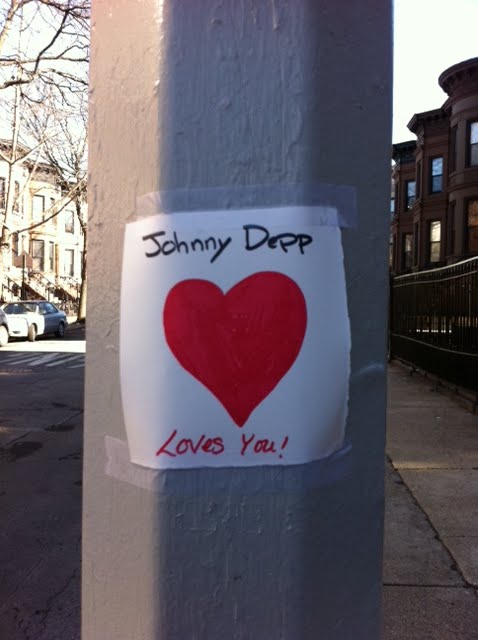
On the mention of Johnny Depp, our art project was born. Avia took a card, and wrote Johnny Depp Loves You on it, with a big red heart. We each then started making cards with similar messages. Prince Loves You. Lady Gaga is Gaga Over You.
Then I made one that says Alice Walker wrote a book about you, and I decorated it with a little collage made of the color purple. And then I made one that says Oprah thinks you're smart. And Christian dazzled the table with Cezanne Painted Me, Europe Loves You, and the one that melted my heart the most: simply, I Love You.
I had hoped we would all go out together and hang them and photograph them, but it was both late and dark, so we split them up (without looking, so we could neither intentionally choose our own or our favorites) and decided to hang them and photograph them in the morning. To be honest, it was hard to let the art pieces go -- I wanted to chaperone them all into the world. I wasn't very gracious about this either, when I woke up and found that Josh had taken some to put up. I completely understood why he had -- because I hadn't had the time to tell him I hoped we could do it together. It was an opportunity to practice many of the mides (middot) -- patience, order, and equanimity come to mind -- but I don't think I did a good job with any of them. Instead, I can reflect on what was so hard for me, and hopefully be more relaxed the next time.
I feel like the blog has gotten away from a Mussar perspective lately -- and this Never Done activity has brought me back, because it was such a wonderful combination of self and other. I thoroughly enjoyed making the art, and sharing the art making process with others, and being influenced by their ideas (humility.) And when I did go out and chaperone some pieces into the world, putting them up allowed me to think about how others might encounter them and be moved by them. It was both a public gift and also a private gift -- public art speaks to individual people, and so I tried to place them where everyone could see them, but knowing that certain people would relate to them in a special way. The most successful of these was when I hung I Love You on the fire station door frame. I also liked thinking about how they might be left or taken -- that I was giving individuals the opportunity to leave the art there for others, or to take it for themselves. And that it really wasn't up to me to know what was the right thing for any individual to decide to do.




Sunday, February 13, 2011
I met L
Never Done: Met L
On the down side, Josh has been so sick with bronchitis that we had to miss his mom's 90th birthday party in Potomac. On the upside, we (mostly Josh) made her a super sweet art project, photographed it, and emailed it to Josh's niece-in-law along with a letter. The art project was a little mosaic of a duck with a green umbrella.
Here is the story of the duck: Josh's mom (Tsip) loved her first day of kindergarten because she learned how to draw a duck with a green umbrella. On the second day the teacher said, "Today we're going to play with blocks." Tsip raised her hand and said, "I don't want to play with blocks. I want to learn to draw!" But the teacher repeated, "Today we are going to play with blocks." So Tsip raised her hand again and asked to go to the bathroom. When she received permission, little Tsip walked right past the bathroom, and straight home. When the school called her mom in for a conference, they strongly suggested that Tsip wasn't mature enough to start school yet. So she got another year at home with her mom, during which time her mom taught her how to embroider and do other needle crafts.
She became a wonderful artist; she studied at the Art Students League after she got out of high school, and she went on to be a leading figure in the revived art of Jewish paper cut, and also a painter, stained glass, and mosaic artist. We had the idea for the duck mosaic before we knew we couldn't make it to her party, but once it fell through, it became a consolation for our absence.
Another consolation for our absence is that I was able to go to the teenager panel of our adoption classes. One of the ten mandatory classes is a panel of teens who are paid to be experts, and to tell us what it is like to live in the foster care system. The woman leading our sessions has been telling us about one child (L) who she thinks might be good for us, but she had told us she wouldn't be able to bring him to this panel, and in fact, he wasn't there when it started. But four of the teens I met the last time were there, and another seven I had never met. Most of these youth live in an LGBT group home, and ranged in ages from 15-19. I cannot tell you how smart these youth are. And funny. And honest. One of them said, "I hate to break it to you, but teenager fun isn't the same as adult fun. I mean, I'll take a walk in the park with you if you want, but I'm not gonna pretend it's fun!" Another one, when we were having a "boo in the room" conversation, after a prospective parent had said there is no way anybody is going to have anybody over in their room, said, "You know, we are all sexual beings. At least, I am. I am 17 years old, and I have a steady boo. And we are going to find somewhere to go. I would think you would rather we be safe, under your roof, than out in a club somewhere." What I loved most about that moment was that one of the parents looked at him, and said, "You know, you're right. That's a really persuasive argument." And just like that, the whole point of the panel was validated: we were there to learn from them.
It just so happens that this week's mide (middah) is Humility: Seek wisdom from everyone. (Yes, I completed my first cycle through all the mides (middot) and am back to the beginning again.) Not all the teens show their wisdom as easily as the boy I quoted above, but they were all consistently good at reminding us that humility would be a useful tool to being a good parent.
Once the panel was already underway, a beautiful, littler boy, all wrapped up in a down jacket, arrived and slouched into a seat near the door. Our group leader caught my eye and discreetly pointed to him, and mouthed his name. So this was the boy she has in mind for us. He barely said a word the whole time he was there, and when he did, he mumbled it, facing the other direction. I think our group leader has thought of him for us because he's out already at the age of thirteen, and she knows we would love to parent a younger LGBT child. I couldn't pick much of the personality she had described to me -- talkative, funny, and wry -- and yet, through his sullen presentation, I could see a glint in his eye, and a little wry smile. But afterwards, when he was talking with a girl (R) who lives with him at the RTC (residential treatment center, where these kids are essentially being "treated" for being homeless, but really, it's a new word for an orphanage -- a big institution where foster kids live) he was animated and engaged. I spoke with them both -- I remembered R, who I had liked a great deal the last time we met. She asked me if I was done with my classes yet, and I told her I was, but that I wasn't certified yet until I got a bigger apartment. She looked me in the eye and said, "Remember me." I told her I would.
Later, when I spoke with our group leader, she told me L has the flu, and that is why he was so quiet on the panel, and she also said that she knows someone who is probably taking R. I felt my heart sink a little -- I had remembered her very well, as a matter of fact, and had thought she might be my kid. But then the sinking was immediately replaced with delight that someone is stepping up to take her, and with the sudden understanding of what the leaders have been trying to teach us for months now: that it doesn't really matter which child you get. If what you want to be is a parent, then it's about your making an unconditional commitment to a child -- any child -- and it will be tough, and it will take patience, and that's what parenting is.

Saturday, January 29, 2011
Everything bad is good for you
Never Done: Randomly met the author I've most relied on to validate my midlife career change
At the food coop.
Packing apricots into little plastic bags.
I knew that my food coop mate is married to an author, and I knew that he had most recently written a book about innovation, which I once tried to find at the local book store but since I didn't have his name, and I was asking one of the less experienced people at the store, we didn't come up with it from just the word "innovation" and my saying that he's a local author who had done many readings in the store -- which now that I know the title (Where Good Ideas Come From: A Natural History of Innovation) I find ridiculous.
I had been looking forward to seeing all my coop shift mates, since we hadn't seen each other since late November (many of us missed our New Year's eve shift) but Alexa, Lucy, and Rose weren't there, and instead there was a room full of subs along with me and Justine. Nice, smart, friendly subs. Subs I enjoyed talking with. One of whom turned out to be Steven Johnson. Which you knew already because I already told you about Where Good Ideas Come From, but put yourself in my shoes. You're hanging out for hours in a chilly room, packing dried fruits, nuts, and candy into little bags, and you're shooting the shit with the other people in the room. If you don't already know each other, then all you know you have in common is that you (probably) live in Brooklyn, and you are members of the Park Slope Food Coop. So you slowly find your way to points of common interest. You move in and out of conversations with the people packaging cheese and olives, and the people packaging tea and spices. You overhear someone talking about "lunch freedom" at public middle schools, and you jump into a conversation about good TV shows. You realize that one of the subs is the husband of a wonderful playwright and TV writer friend, and you start talking with him and another guy. You discover you have a connection to NYU. The other guy went to Interactive Telecommunications Program (ITP) and then taught in the department. They ask if I'm writing plays. I say I'm more writing screenplays and I mention my new web series. The other guy asks particularly smart questions about this. We find out he's a writer when he talks about questions of creative license in regards to the treatment of a book of his that was optioned.
Hey, this is what it's like down in food processing.
More and more of the room's attention turns to him as he talks about the optioned book, The Ghost Map, which is about the 1854 cholera epidemic in London, and how one physician, John Snow, deduced that cholera is water born and not air born -- and in doing so, changed science, cities, and the modern world. People started to ask him what else he had written. Among other books, he mentioned a book called Everything Bad Is Good For You: How Today's Popular Culture is Actually Making Us Smarter.
Wait, what? I love that book. No, seriously, I love that book. It came out the year I came out of grad school, with an MFA in dramatic writing, and hopes and goals of being paid to write for the big and small screens. Having left the non profit social justice world for the world of film and television, I was feeling a little vulnerable. Vulnerable that I wouldn't actually get paid work, and vulnerable that if I did, that that I'd end up writing for Who Wants to be a Millionaire? (which I did try to write for, which I would have been thrilled to have done, but which would have made me feel like I was less of a contributor to society than if I was still, for example, working with low-wage, immigrant workers.)
And then I read Steven's book, which proposes that as TV, video games, and film evolve, the level and complexity of their narratives also evolve, giving us, the viewer and the player, more opportunities for cognitive development and narrative engagement than ever before. (I wish my books weren't in storage, or else I'd go to the source and give you some quotes. Or at least filch some blurb language.) But really, you should go read it, and I'll stick to the part that's most important to me: this book made validated my career choice, and also made me more open-minded about video games. I have several young friends who are extremely into video games, and I don't think I would have respected their interest if it weren't for this book.
From a mussar perspective, I think this one falls under the category of Humility: Seek wisdom from everyone, including the guy sitting next to you, packing apricots into little plastic bags, and including fourteen year-old gamers.
Also, I feel like I should tell you in advance what my next post will be about. I am going to try to go an entire day without saying anything negative or pessimistic, which although I probably did it as a very little child, I have probably never done it in, say, the past 45 years.
Saturday, January 22, 2011
I saw past the blemish to the beauty
Never Done: Saw a staged reading of a new opera of Enemies, A Love Story, by Isaac Bashevis Singer, with a new libretto by Nahma Sandrow
This is the second time in as many months that I have written that the thing I had never done before was to see a world premiere of a work that Nahma either translated or wrote, which has a lot more to say about what Nahma is out there accomplishing than what I am, except that I think that supporting and learning from our colleagues (Humility: Seek wisdom from everyone) is a vital part of the creative process. Really. I once took a master class in acting from Marian Seldes in which she spent as much time (literally) teaching about how to be a good audience member as she taught how to be a good actor. I will probably never forget her modeling how to sit in the audience, leaning slightly forward, in rapt attention -- her point being that the job of the audience member is to give as much attention and energy to the actor as the actor is giving to the audience. Her class reminded me that my friend Barbara teaches first graders how to listen, and they practice sitting across from each other making encouraging sounds like, "mhmm" and "oh." (I found this out because when I still lived in Portland I used to go help her take her class apart at the end of the year, and I found a piece of butcher paper with an illustrated three-step tutorial on how to be a good listener.)
This being New York, and the theater community being small, I later found myself in audiences with Marian, where I saw that she does, in fact, sit perfectly still -- fidgetless -- and completely attentive, with an interested look on her face. Unlike Edward Albee, who sat behind me recently during a Public Theater production that I thought was well above average, and also both politically and emotionally ambitious, and also had one of the best raised poor characters I've ever seen on stage, and he alternately slept and complained through the first act, and then didn't come back for the second. I myself usually fall somewhat in between. I aspire to be like Seldes, but I sometimes fight back the sleep, and sometimes I succumb.
I think I was a good (which as I think about it, means that I was an ethical) audience member at Enemies. I wasn't as still as Marian suggests, because I was still fighting off a sore throat, and needed to sip tea, and once to unwrap a vitamin C throat lozenge. But I paid close attention, and I gave the actors my energy and attention. And here's the thing: it wasn't necessarily so easy to do, because even though I was super interested in the libretto and the plotting, and even though a couple of the singers were wonderful, the guy who played the main character swallowed his words, making it really difficult to understand, and the music was ... well the music was ... well the music was ... I hated the music. There, I said it. I hated the music. It made me want to act out. It made me want to whisper judgmental things to the people I was with. But I didn't. (Unless I am right now. Which I am a little worried that I might be.) Instead, I sat and paid attention to the parts I was far more interested in, which took at least five mides (middot) to accomplish: patience, equanimity, humility, decisiveness, silence, and calmness. And diligence too. In the end, I think everyone was the better for it, but I know I was.
I live with someone who does this extremely well -- he sees right past the blemish to the beauty, whereas my mind tends to get stuck at the blemish. (There are some downsides to this -- cleanliness and order are not his strong suits, but they are mine.) I've been trying to get better at seeing the past the blemish to the beauty for years, and have started to see some real progress recently. I'll take my experience at Enemies as a success, and will keep building from there.
Monday, January 10, 2011
One degree of separation from Michael Jackson
Never done: Met Sarah, Andy, Jay, and Peter, and saw a rough cut of a film that no-one but the filmmakers have ever seen before
For the past six months or so, Josh has been editing a film about the god-like violinist Jascha Heifetz. For the past six months, the writer on the project, Sarah, has been asking to meet me. Finally, the day came when they had a rough cut together, and needed some outside eyes to give them feedback, and they invited me into the editing room, along with two extremely accomplished violinists, Andy and Jay, and the film's producer/director, Peter.
I love, love, love, love, love getting to tell other people what isn't (and is) working with their movie. Especially when I do not have to figure out how to fix it. I know that sounds a little sadistic, but I actually mean it in the most generous possible way. I love taking that time to help midwife a piece of art, and I love coming in cold, with beginner's mind, and paying attention to what does and doesn't interest me, what is confusing, and what story is -- and isn't -- being told.
The only thing that was off about this screening is that the two violinists were introduced as such -- this one is a famous, but now injured and retired virtuoso, and this other one is a famous violinist who plays in the house band on Prairie Home Companion, and has also played with Itzhak Perlman, Placido Domingo, Michael Jackson, and as written on his bio, the Native American occupying force on Alcatraz. I was introduced as Josh's companion. Nice.
But as it turned out, Andy and Jay were two of the most respectful and down-to-earth famous violinists I've ever critiqued a film with. (Yes, and the first.) I loved the way our three sensibilities wove together, and I loved listening to the ways that they watched the film. They said things like, "You should hold that shot until he hits the E chord in The Girl With the Flaxen Hair." And, "You had a theme from Porgy and Bess playing under a scene from the 1920's, but it wasn't composed until 1935." One of them, and I'll leave it to your imaginations which one, also said, "It's about a fucking violinist, let him play the fucking violin!"
Meanwhile, I was giving notes like, "I feel like the story really starts at minute 11, when we first learn that his father never approved of anything he did," and "The first-person narration is confusing, especially if you aren't going chronologically," and "If you're going to mention suicide, you can't toss it away so quickly. If we know why, we can better empathize with him."
And what happened, and what makes me think that Andy and Jay are such mentshes, is that we all listened to one another, and usually agreed with one another, and definitely respected one another's opinions. So even though as far as they were concerned I could have known as much about story structure as I knew about natural language programming (which my sister knows a lot about) they didn't act like it, and that is a quality I respect more than almost any other. In our Mussar practice, it's Humility: Seek wisdom from everyone.
This experience reminded me that we can learn as much when someone else models ethical behavior as when we ourselves model it. And what I learned, and hope I never forget it, is that if you're making a movie about a fucking violinist, let him play the fucking violin!
Thursday, November 11, 2010
Remember
Never Done: Started my Mussar journal
I feel confessional. I have not had time to start writing my screenplay in 21 days (but I did complete all the preliminary work, and think it would be good for me to do it.) I have not had time to unpack my office in the month since I've lived in this new apartment. And a week into my Mussar Va'ad, I hadn't written in my journal, which is the foundation of the daily practice. And then I did. I did it using that old chestnut of a trick -- I told myself it would only take 10 minutes. So after lunch, I pulled out my Nikki McClure Remember journal and I wrote. And guess what? It did only take 10 minutes, and in that time I learned something significant about myself and humility.
I have plenty of it when I am the student. Where I get into trouble is when I am the teacher.
Experienced teachers: When you know you are more knowledgeable about your subject than your student(s), how do you teach from a place of humility?
Sunday, November 7, 2010
Seek wisdom from everyone
Never Done: Attend first adoption preparation class
As I have previously written, in order to become an adoptive parent, you have to take Group Preparation and Selection (GPS)/Model Approach to Partnerships in Parenting (MAPP) training for prospective foster and adoptive parents. It's a series of 10 classes, offered in a continuous loop -- you can jump in any time. As it happened, Josh and I jumped in on the most intense and real of all classes -- the youth panel, where 10 young people, ranging from ages 14 to 19, all hoping for adoption placements, talk to a group of prospective placements. We went to the LGBT Center, because I thought I'd be more comfortable being myself with the agency people there than in a straight group. It was the right choice -- the prospective parents ranged from a gay male couple, to two single lesbians, to five straight couples, to me and Josh. At least one of the women leading the training was queer, and at least 4 of the youth present were, as well. In fact, the only discomfort I felt all day long was when someone asked the youth if they had a preference about their parents' sexual orientation or race, and one of them said that they didn't care, but if it was two men, they didn't want to see them kissing and stuff in public. I felt the air sucked out of the room. Here we were at the Center, and there was a gay male couple sitting right there. There was a lot of jovial concurrence among the youth, until I jumped in with a question: "Do you feel that way about any parents? Or just gay parents?" And then it came out that all of them felt that way about any parents. "What you do is what you do, but we don't want to have to see it." Ahhh, and the air started filling the room back up.
For three hours, the facilitator asked the teenagers questions, and we asked each other questions. My mide (the Yiddish word for the Hebrew word middah, or character trait) that the Mussar Va'ad is going to focus on this week is Humility -- seek wisdom from everyone. With that awareness, I listened even more attentively than I might have.
Here's what I learned. Not one of these particular teens cared what the race or sexual orientation of their parents would be. But they don't want old parents. "That's when they get cranky." They want respect. Patience. Honesty. Parents who would give their all, and not give up. They want people to choose adopting because they want to, not because of some sense of charity. They want to be given limits -- the younger children asked for curfews -- and thoughtful discipline. One girl asked the mothers in the room if we would want mother-daughter days to go get our nails done, or to go shopping. The older ones made it clear that they are used to being on their own -- but that they need support to become successful adults. Most of them want to be free to go "out" and not to tell us where "out" is. This got the biggest push back from the prospective parents in the room. Later, one girl told me one on one, "You know, when kids say they are going out, they are smoking. Just so you know." This same girl had told us earlier that she wants to be a rapper, and if that doesn't work out, a social worker, which made most of the adults in the room laugh. But as I thought about it, I realized that's really very close to how I have lived my life -- going between social work, organizing work, and being an artist. So I fought the urge to laugh, and re-dedicated myself to listen even more carefully, and to learn from everyone in the room. Humility.
Subscribe to:
Posts (Atom)